(Post by: Madie Hobbs)
I’ve been thinking a lot about the disciples this Easter. About what they would have been thinking, feeling, expecting this week. Scripture tells us that Jesus’ true plan for the week was hidden from them, but there were still many momentous events taking place.
They’re travelling into Jerusalem together to celebrate Passover, a tradition many of them had likely experienced since childhood. It was a time of seeing old friends, swapping stories of what had happened since last year, reminiscing about all the years before. And now there was Jesus to discuss of course. He was busy performing miracles and building His Father’s kingdom, perhaps playing with the children not unlike He had once been, making this journey with His parents, and serving in an unobtrusive, eager manner.
All the while, the one thing weighing on His mind was likely that this was the last Passover humanity would ever need. This time, evil would not pass over. It would rest on one man alone, on Him, and would demand blood.
Not long ago, I was reading about a famous artist in the book I mentioned last time I wrote to you. His name was Michelangelo Merisi da Caravaggio, and he defined artistry. He made his living creating some of the most beautiful and well-known religious paintings in history, and he lived his life constantly running from justice. He was violent, underhanded at times, and a murderer. Yet the church protected him, for he rendered too great a service to Christianity to be lost due to mere indiscretion and folly.
The models he often used for his paintings were no better than himself. They were murderers, prostitutes, drunkards, and beggars. Yet what he transformed them into is now worth millions and has maybe even added a multitude to the kingdom of Heaven.
Caravaggio was a man at war with himself. As I read about him, I felt almost a sort of kinship. An understanding that there is darkness we must deal with, yet there lies beauty in it, even behind prison bars and a cloud of confusion.
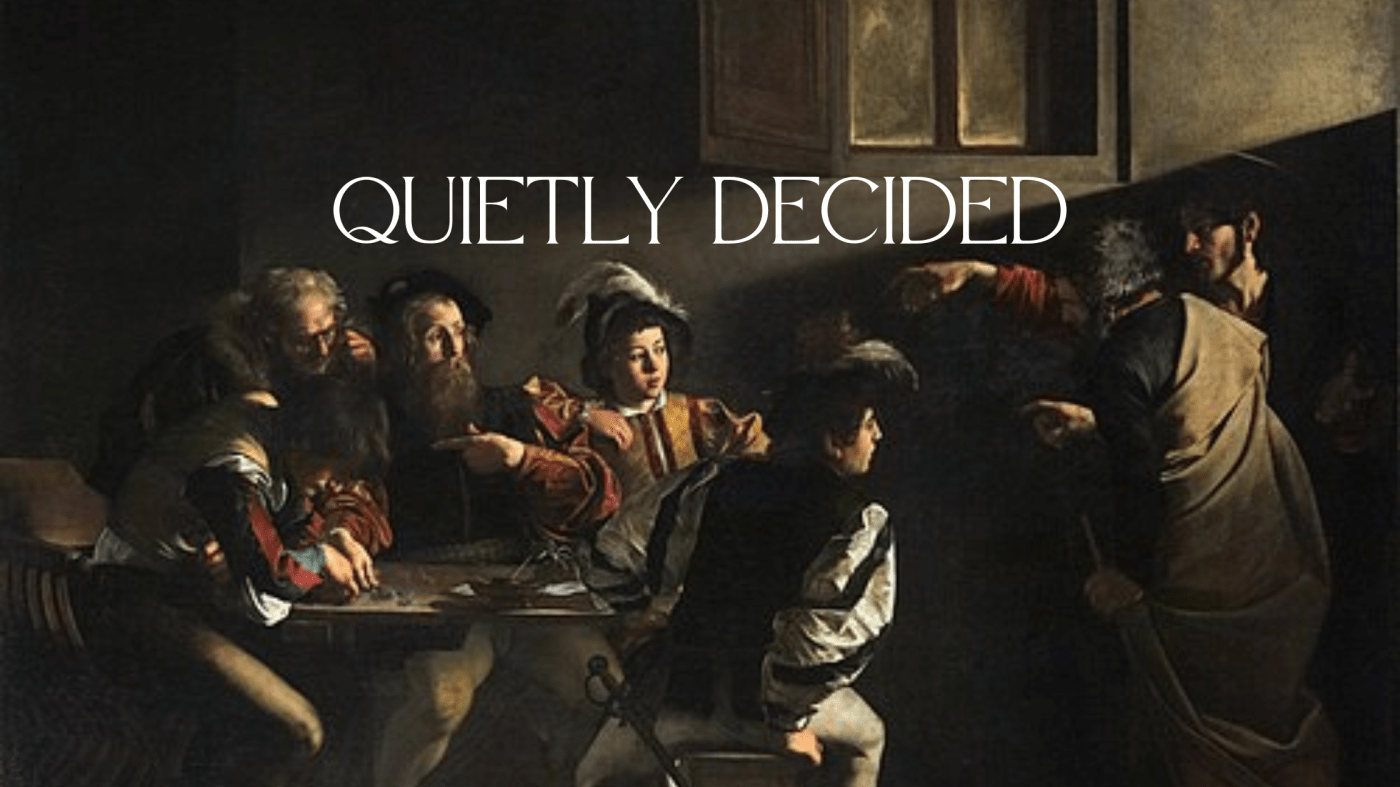
One of his paintings, The Calling of St. Matthew, is of particular note. The author of the book I am reading describes what happens in these scene rather beautifully, and a little differently from what I normally imagined of it.
I imagine this encounter would have been ringing through the halls of Matthew’s mind as they travelled to and arrived in Jerusalem, where people likely scorned, whispered about, and looked down upon him. Yet Jesus would have been there. Entrusting Matthew with His ministry, knowing He would soon be one of the shaping voices for every Christian yet to come.
Matthew had been a tax collector, and would’ve been hated even more than Roman tax collectors, for he was a Jew, robbing his own people. Yet there was Jesus. He decided one day that Matthew was in need of a new profession, and lucky for him, Jesus had a position readily available. The very same day Jesus called him, Matthew hosted a dinner at his home, where his friends, however few he may have had, and the religious leaders were in attendance. These leaders in particular had some choice words to say about Matthew, and Jesus’ association with him.
Caravaggio’s painting of this is described like this:
“When their questions reached Jesus, he stiffened. “By what rule do you think God measures out his favor? Do you think what he wants is religious precision? Do you think because you have made for yourselves rules and then kept them that God prefers you to those who know their lives have fallen apart? It’s the sick, not the healthy, who need a doctor. But you despise the sin-sick among you. Didn’t God say through Hosea, ‘I desire mercy, not sacrifice.’ Will you ever learn what this means? I draw near to the broken so they might hear the voice of mercy. I’m not here to change their minds; I’m here to change their hearts.”
As he listened to Jesus and the pharisees argue over him and his friends, Matthew quietly decided he would follow Jesus from then on. No one had ever defended his dignity like this before. Jesus knew the ugly truth – He knew Matthew had chosen money over God. Yet here stood Jesus in his home, defending his right to befriend the marginalized and the outcast. Wherever it took him, whatever it cost, he would follow Jesus, even if it meant following him all the way to the end of his life.”
~ Russ Ramsey, Rembrandt is in the Wind
Caravaggio brought this to life with nothing more than some paint and a canvas, in the midst of a tumultuous life, and conveyed a story which brought me to tears the first time I read it.
Now, I can see Matthew, sitting opposite Jesus, a campfire between them on their journey, and this encounter filling his thoughts. How could he see Jesus as anyone but the only person to defend his dignity? As the only one to know the dark truth of what Matthew had chosen and still offer him a seat at His Passover table.
Caravaggio died, alone on a beach, bleeding from a wound inflicted by a group of knights he once vowed his allegiance to, as his corrupted life came closing in on him. No one knows for sure, but I like to think that his own paintings perhaps came to mind in his final moments, that perhaps Jesus sat opposite him, too, and reminded him of the commissions he carried out that meant so much. That perhaps Caravaggio finally had his own moment of decision, that wherever it took him, whatever it cost, he would follow Jesus.
I believe we all have these moments. I know I certainly have, sitting at my tax collector’s booth, or bleeding out on a desolate beach, when no one else would come to sit next to me.
Yet there was Jesus.
As I make this journey to the cross with Him again this Passion week, as I hold His gaze from across the fire, as I believe in Him, I once again have decided that wherever it takes me, whatever it costs me, I will follow Him, even if it means following Him all the way to the end of my life.



 The Few
Leave a comment